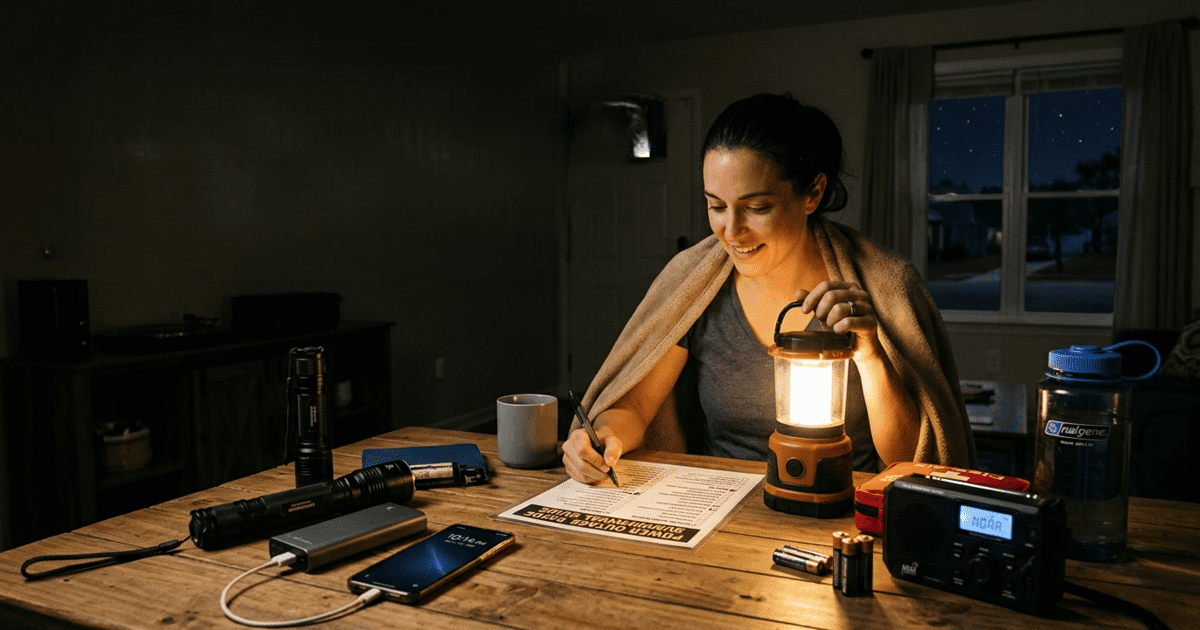

The lights go out. The fridge stops humming. Your phone is the only glow in the room.
Most people panic. Not because the situation is dangerous — but because they have never thought about what to do next. And honestly? That used to be me too.
I grew up in a country where power outages are not emergencies. They are Tuesday. Load-shedding schedules, monsoon damage, grid overload during summer — losing power for 4 to 8 hours was just normal life.
You adapt. You learn. You figure out what actually works to survive a power outage and what is a complete waste of money.
Then last year, floods hit our area. We lost power for nearly three days. Not scheduled. Not predictable. Roads were submerged, cell towers went down, and the inverter battery died within the first night.
That experience changed how I think about power outages entirely. A 2-hour outage is an inconvenience. A 2-day outage with no preparation is genuinely frightening.
This guide is not theory. It is what I know from learning to survive a power outage firsthand — short ones, long ones, and the kind where you are not sure when power is coming back.
Replace or expand the flood experience above with your specific details — how long power was out, what failed first, what surprised you most, what you wish you had prepared. Keep it real. This is the E-E-A-T differentiator.
Why Power Outages Are Getting Worse
This is not just an India or US problem. It is global.
In India, the grid handles 200+ GW of peak demand during summer. When temperatures hit 45°C and every AC unit runs simultaneously, something gives. Load-shedding returns to cities that thought they were past it.
In the US, over 1,500 major outage events happened in 2024. Aging infrastructure, wildfires, hurricanes, and ice storms are pushing the grid harder every year.
The pattern is the same everywhere: more extreme weather, more demand, same old infrastructure.
Whether you live in Delhi or Dallas, the question is not IF you will need to survive a power outage. It is when, and for how long.
How to Survive a Power Outage in the First 30 Minutes
Do not light candles. Seriously. More house fires start from candles during outages than from the outage itself.
Here is what to do instead:
Step 1: Check if it is just your house. Look outside. Neighbours dark too? It is a grid issue. Just your house? Check your circuit breaker.
Step 2: Unplug sensitive electronics. When power comes back, the surge can destroy TVs, computers, and routers. Unplug them now. Keep one lamp plugged in so you know when power returns.
Step 3: Limit fridge and freezer opening. This is the single most important thing. A closed fridge keeps food safe for 4 hours. A closed freezer lasts 24 to 48 hours. Every time you open the door, that timer drops significantly.
Step 4: Check your phone battery. If it is below 50%, switch to low power mode immediately. You might need that phone for 24+ hours.
Step 5: Grab your emergency kit. If you have one. If you do not, keep reading — we will fix that.
The Emergency Kit to Survive a Power Outage
Every “emergency kit” list on the internet has 47 items. Nobody builds that kit. Here is what you actually need — tested in real outages, not copied from a FEMA brochure.
| Item | Why It Matters | Approx. Cost |
|---|---|---|
| LED flashlight (2 minimum) | Candles are fire hazards. Period. | $10-25 / Rs 300-800 |
| Extra batteries (AA, AAA) | Match them to your flashlights | $15-20 / Rs 200-400 |
| Power bank (20,000+ mAh) | Charges your phone 4-5 times | $25-50 / Rs 800-1,500 |
| Battery-powered radio | Cell towers go down in major events. Radio does not. | $20-40 / Rs 500-1,200 |
| First aid kit (basic) | Injuries happen in the dark | $15-30 / Rs 300-600 |
| Cash (small denominations) | ATMs and card machines need electricity | $100-200 / Rs 2,000-5,000 |
| Water (1 gallon per person per day) | If pumps lose power, taps stop | $5-10 / Rs 100-200 |
| Non-perishable food (3 days) | Crackers, peanut butter, canned goods | $20-40 / Rs 500-1,000 |
Total cost: under $150 / Rs 4,000. Build it once, check it every 6 months. That is it.
One thing most lists skip: a physical list of emergency phone numbers. Your contacts are on a phone that might be dead. Write down the numbers that matter — family, local emergency, utility company — and keep them with your kit.
Share what was in your kit vs what you wish you had. What did you grab first during the floods? What was useless? What saved you? Example: “The power bank was the most valuable thing we owned for those three days. Everything else was secondary.”
Keeping Food Safe Without Power
Knowing how to handle food is critical when you need to survive a power outage that lasts more than a few hours. The rules are simple but people get them wrong:
Fridge (4 hours rule): A closed fridge stays cold enough for 4 hours. After that, perishables become unsafe. Eat dairy, meat, and leftovers first. Condiments, hard cheese, and sealed drinks last longer.
Freezer (24-48 hours rule): A full freezer holds temperature for 48 hours. A half-full freezer lasts about 24 hours. Do not open it “just to check.” Trust the timer.
What to throw away after 4+ hours without power:
| Throw Away | Safe to Keep |
|---|---|
| Raw meat, poultry, fish | Hard cheese (cheddar, parmesan) |
| Milk, cream, yogurt | Butter, margarine |
| Cooked leftovers | Fresh fruits and vegetables |
| Opened baby formula | Bread, rolls, cakes |
| Cut fruits | Peanut butter, jelly |
| Soft cheeses | Uncut raw vegetables |
The sniff test is not reliable. Bacteria that cause food poisoning do not always change smell or appearance. When in doubt, throw it out.
Traditional methods that still work: In many parts of India and Asia, people have survived without refrigeration for centuries. Earthen pot cooling (matka), salt preservation, and drying foods in the sun are not outdated — they are proven.
If you are facing an extended outage, these methods are worth knowing. For more on buying electronics like power banks and backup devices smartly, check our guide on buying refurbished electronics — you can save 30-70% on backup gear.
Staying Cool Without AC
This is where Indian experience genuinely helps. When your region routinely hits 40-45°C with power cuts, you learn fast.
What actually works:
-
Wet cloth on windows. Hang a wet towel or sheet over open windows. Breeze passes through, drops the temperature noticeably. Old technique. Still works.
-
Earthen pot water. Water stored in a clay pot (matka) stays cool through evaporation. No electricity needed. Been working for 5,000 years.
-
Sleep on the floor. Heat rises. The floor is the coolest surface in your house. During extended summer outages, this is standard practice.
-
Wet your wrists and neck. Major blood vessels run close to the surface there. Cooling those spots cools your entire body faster than a wet towel on your forehead.
-
Stay hydrated. You lose water faster than you think when sweating without AC. Drink before you feel thirsty.
If you are dealing with a summer outage specifically, our guide on how to survive extreme heat covers cooling methods in much more detail.
For cold climates (winter outages):
Layer clothing. Gather everyone in one room. Use blankets and sleeping bags. Close off rooms you are not using.
Body heat in a single room is surprisingly effective. If you have a fireplace, use it — but never bring outdoor grills or generators inside. Carbon monoxide kills silently.
Communication When the Grid Goes Down
Communication is one of the hardest parts when you try to survive a power outage that takes down cell towers too. Your phone is your lifeline. Protect it.
Battery conservation (can triple your phone life): – Airplane mode when not actively calling or texting – Screen brightness to minimum – Close all apps running in background – Turn off Bluetooth, WiFi, location services – Use SMS instead of WhatsApp or iMessage (uses far less power)
If cell towers are down: – AM/FM radio still works. Always. Battery-powered or hand-crank. – If you have a car, the car radio works and the car can charge your phone – Landline phones (the old wired ones) often work during outages — they have their own power source
Community networks matter. During the floods, our neighbourhood WhatsApp group was the fastest source of information — faster than news, faster than official channels. Before the next outage, know your neighbours. Seriously. The person next door with a generator might be the most important contact you have.
Backup Power Options to Survive a Power Outage
Not every solution fits every situation. Here is an honest comparison.
| Option | Cost | Runtime | Best For | Drawback |
|---|---|---|---|---|
| Inverter + battery | Rs 8,000-25,000 / $200-500 | 4-10 hours (fans, lights) | Daily outages (India standard) | Limited to small loads |
| Portable power station | Rs 25,000-80,000 / $300-1,000 | 4-20 hours | Apartments, short outages | Cannot run AC or heavy appliances |
| Petrol/diesel generator | Rs 15,000-60,000 / $300-1,500 | As long as you have fuel | Extended outages, rural areas | Noisy, fumes, fuel storage risk |
| Solar panel + battery | Rs 40,000-1,50,000 / $500-2,000 | Unlimited (daytime charging) | Long-term, off-grid backup | High upfront cost, weather dependent |
| UPS (computer) | Rs 3,000-8,000 / $50-150 | 15-45 minutes | Protecting computers, routers | Very short runtime |
| Car battery + inverter | Rs 2,000-5,000 / $30-70 | 2-4 hours | Emergency backup if no other option | Drains car battery |
My honest recommendation: If you want to survive a power outage in a region with regular cuts (most of India, parts of Africa, Southeast Asia), an inverter with battery is non-negotiable. It is the single best investment.
For occasional outages (US, Europe), a portable power station or generator makes more sense.
Safety warning: Never run a generator indoors or in a garage. Carbon monoxide is odourless and kills within minutes. Every year, people die from this during outages. Keep generators at least 20 feet from any window or door.
Note: Prices are approximate and may vary by region, brand, and availability at the time of purchase.
When the Outage Lasts Days: Lessons From Real Experience
A short outage is an inconvenience. But trying to survive a power outage that lasts days — the kind that comes with floods, cyclones, or infrastructure failure — is a different situation entirely.
What I learned from living through a multi-day outage during floods:
The inverter dies faster than you think. We ran it conservatively — just fans and phone charging — and it still lasted only one night. If you are buying an inverter, get a bigger battery than you think you need.
Water is the real crisis. When the electric pump stops, the tap stops. We had no stored water beyond what was in the filter. Two bottles for a family. That was a hard lesson. Now we keep 20 litres stored at all times.
Information is power. When cell towers went down, we had no idea what was happening — whether rescue was coming, whether roads were open, whether the water would rise further. A battery radio would have changed everything. We did not have one.
Community saved us. A neighbour with a small generator shared charging slots for phones. Another neighbour had stored water. We shared food. Nobody survived that situation alone. Nobody.
The government helpline was useless for the first 48 hours. Not because they did not care, but because they were overwhelmed. Do not plan around being rescued. Plan around surviving until things normalize.
Expand this section with your specific flood experience. What failed? What worked? What would you do differently? The more specific and honest you are here, the more valuable this section becomes. This is the content Google cannot find anywhere else.
Power Outage Preparedness: 10-Point Checklist
-
Build your emergency kit today. Not tomorrow. Today. The list is above — under Rs 4,000 / $150.
-
Store water. Minimum 20 litres (5 gallons) per person. Replace every 6 months.
-
Invest in a power bank. 20,000 mAh minimum. Keep it charged. Always.
-
Get an inverter or backup power. Match it to your situation — daily outages need an inverter, rare outages need a power station.
-
Know your fridge timeline. 4 hours fridge, 24-48 hours freezer. Write it on a sticky note. Put it on the fridge.
-
Save emergency numbers on paper. Phone might be dead. Paper does not need charging.
-
Keep cash at home. ATMs and card machines need electricity. Small denominations.
-
Buy a battery-powered radio. When cell towers go down, radio is the only broadcast medium that works.
-
Know your neighbours. The community around you is your best resource during extended outages.
-
Practice once. Turn off your main breaker for 4 hours on a weekend. See what gaps exist in your plan to survive a power outage. Fix them before the real thing happens.
Key Takeaways
-
Learning to survive a power outage is not optional — outages are increasing globally and preparation is practical.
-
The first 30 minutes matter most. Unplug electronics, close the fridge, check your phone battery.
-
An emergency kit costs under Rs 4,000 / $150 and covers 90% of what you need.
-
Food safety has hard rules — 4 hours for fridge, 24-48 hours for freezer. Do not guess.
-
An inverter with battery is the best investment for regular outage regions. For rare outages, a portable power station works.
-
Your community is your backup system. Know your neighbours before the crisis, not during it.
-
Practice a simulated outage once. The gaps in your preparation will become obvious immediately.
Note: Product prices mentioned in this article are approximate and may vary. This article provides general safety information for educational purposes only. It is not a substitute for official emergency guidance from government agencies.
Further Reading:
This article provides general safety information for educational purposes only. It is not a substitute for official emergency guidance. Always follow instructions from local emergency services. See our full Disclaimer.